




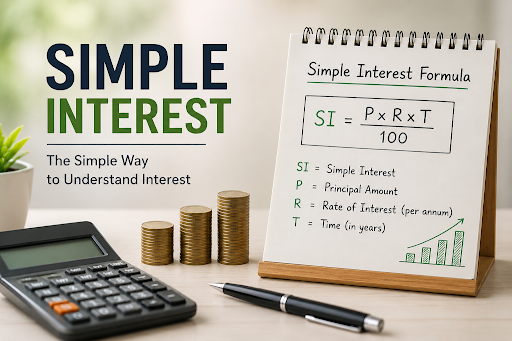
Understanding financial concepts is important for making informed decisions, especially when it comes to loans and investments. One of the simplest financial concepts you’ll encounter is simple interest. In this article, we’ll delve into the meaning of simple interest, the formula used to calculate it, and some everyday examples to illustrate how it works, particularly in the context of personal loans for home renovations.
What is Simple Interest?
Simple interest refers to a method of calculating the interest charged or earned on a principal amount over a specific period. Unlike compound interest, which is calculated on the initial principal as well as on the accumulated interest, simple interest is straightforward and relies solely on the original amount.
Key Characteristics of Simple Interest:
- Linear Growth: The interest grows linearly over time, meaning it’s predictable and easy to calculate.
- No Compounding: Interest earned or paid does not accumulate, making it simpler to understand and apply in real-world scenarios, such as personal loans.
The Simple Interest Formula
The formula to calculate simple interest is quite simple:
[ \text{Simple Interest (SI)} = P \times r \times t ]
Where:
- P = Principal amount (the initial sum of money)
- r = Annual interest rate (in decimal form)
- t = Time (in years)
Example:
If you borrow $1,000 (P) at an interest rate of 5% (r = 0.05) for 3 years (t), the simple interest would be calculated as follows:
[ \text{SI} = 1000 \times 0.05 \times 3 = 150 ]
This means you will pay $150 in interest over the 3 years.
Everyday Examples of Simple Interest
Example 1: Personal Loan for Home Renovations
Imagine you decide to renovate your home and need a personal loan for the project. Let’s say you take out a personal loan for home renovations of $10,000 with a simple interest rate of 4% for a period of 2 years.
Using the simple interest formula:
[ \text{SI} = 10,000 \times 0.04 \times 2 = 800 ]
In this situation, over the two years, you would pay $800 in interest on your $10,000 loan, making your total repayment $10,800.
Why Use Simple Interest for a Personal Loan?
Opting for a personal loan with simple interest can have advantages. For home renovations, where you may be uncertain about your long-term financial situation, the predictability of simple interest allows you to budget effectively without worrying about accumulating interest on previously paid interest.
Example 2: Savings Account
A savings account may also be a venue where simple interest is applied. Suppose you deposit $5,000 into a savings account that offers a simple interest rate of 3% annually. After 4 years, your interest earned can be calculated as:
[ \text{SI} = 5,000 \times 0.03 \times 4 = 600 ]
In this case, you will earn $600 in interest over 4 years, giving you a total of $5,600 in your savings account at the end of that term.
Example 3: Car Loan
Let’s say you take a simple interest loan for a new car purchase of $20,000 at an interest rate of 6% for 5 years. The interest can be computed as:
[ \text{SI} = 20,000 \times 0.06 \times 5 = 6,000 ]
Thus, the total amount you’d pay back would be $26,000, which includes $6,000 in interest charges.
The Advantages of Simple Interest
- Clarity and Predictability: Knowing exactly how much you will owe in interest helps with financial planning.
- Budget-Friendly: For short-term loans like personal loans for home renovations, borrowers can better plan their budgets without the fear of compounding interest.
- Easier Calculations: The straightforward formula allows quick calculations, making financial assessment simpler.
Potential Disadvantages of Simple Interest
- Higher Costs over Longer Terms: For longer-term loans, simple interest may not be as financially beneficial as compounding interest loans, as the total interest can add up significantly.
- Limited Earnings Potential: In savings scenarios, using simple interest could yield lower returns compared to compounding interest accounts, where your earnings can generate additional interest.
Conclusion
Understanding simple interest is essential for making smart financial decisions, particularly when it comes to personal loans for home renovations or other significant purchases. With a clear definition, a straightforward formula, and relatable examples, you can navigate through loans and savings accounts with confidence. Whether you’re borrowing money for a renovation project or looking to grow your savings, knowing how simple interest works can empower you to manage your finances better. Always remember to read the fine print and consider the implications of interest on your financial future, so you can make informed decisions that work for you.