


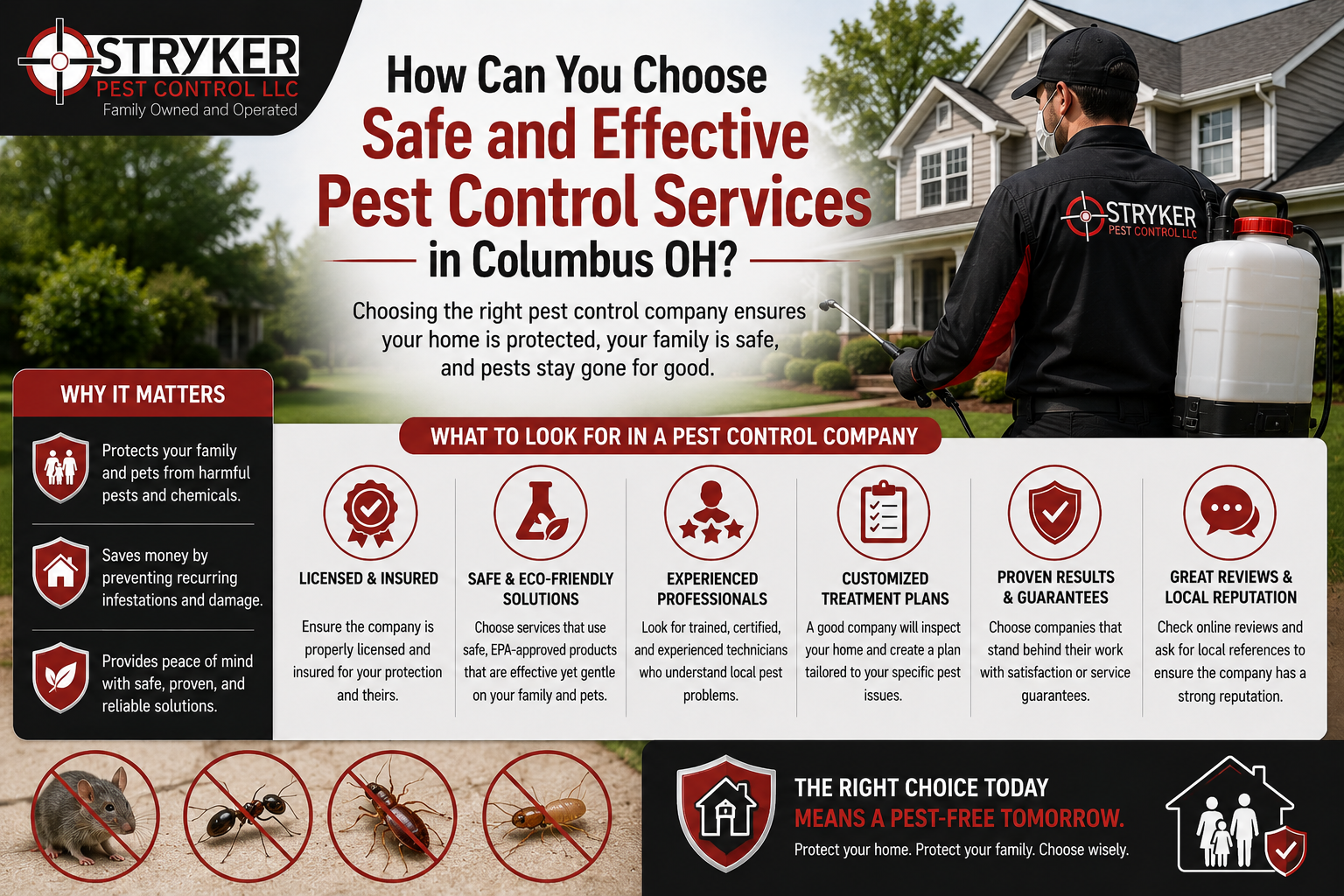
Finding pests inside your home can make any homeowner uncomfortable. Whether it is ants in the kitchen, mice in the garage, cockroaches near the sink, or wasps around the house, the first reaction is often to look for a quick solution. However, choosing a pest control service should involve more than finding a company that promises to remove pests quickly.
Homeowners should also think about safety, treatment methods, technician qualifications, pricing, follow-up service, and the steps a company takes to prevent pests from returning.
For people searching for Pest Control Services in Columbus OH, knowing what questions to ask can make it easier to find a provider that offers a practical and responsible approach to pest management.
Why Is Safety Important in Pest Control?
Pest control services in Columbus, OH can involve products and treatment methods that need to be used correctly. Even when a product is approved for its intended use, homeowners should understand where it will be applied and what precautions are necessary.
The EPA recommends that consumers ask pest control companies about the chemicals or active ingredients being used, how products will be applied, potential health concerns, and ways to reduce exposure.
This is especially relevant for homes with children, pets, older adults, or anyone who may be particularly sensitive to certain products.
A professional company should not make homeowners feel uncomfortable for asking safety questions. Instead, technicians should explain the treatment in clear language and provide instructions before and after the service.
How Can You Check a Pest Control Company’s Qualifications?
Before allowing a company to treat your home, check whether it has the appropriate licenses and qualifications.
Pest control technicians need proper training to identify pests and understand how different treatments should be used. In Ohio, pesticide application and pest control activities are subject to state requirements.
Homeowners can ask whether the company is licensed and whether the technicians performing the work have the necessary credentials.
The EPA also recommends checking a pest control company’s qualifications before hiring it.
A company that willingly provides this information gives homeowners an opportunity to make a more informed decision.
Should a Pest Control Company Inspect Your Home First?
An inspection is an important part of effective pest management.
Before recommending a treatment, a technician should try to understand what pest is present and why it may be entering or remaining on the property.
For example, recurring ants may be entering through a small gap around a window. Rodents may be using an opening near the garage or foundation. Cockroaches may be attracted by food and moisture in a kitchen.
Without identifying the source, treating only the visible pests may provide temporary results.
A professional inspection can help locate entry points, nesting areas, food sources, moisture problems, and other conditions that may contribute to pest activity.
What Treatment Methods Should You Ask About?
Not every pest problem requires the same treatment.
Depending on the situation, a pest control company may use monitoring, traps, exclusion, sanitation recommendations, targeted applications, or other control methods.
Homeowners should ask why a particular method is being recommended.
A good technician should be able to explain what pest has been identified, where it is active, what treatment is planned, and what results the homeowner should reasonably expect.
This information can help homeowners understand the service instead of simply agreeing to treatment without knowing what will happen.
Is Integrated Pest Management a Safer Approach?
Integrated Pest Management, commonly called IPM, is an approach that considers the pest, its environment, and different control methods.
Instead of depending entirely on pesticide applications, IPM can include monitoring, prevention, exclusion, sanitation, physical controls, and targeted treatments when necessary.
The National Pesticide Information Center recommends asking pest control providers about their approach to Integrated Pest Management when comparing companies.
For homeowners, this approach can be useful because it looks at the reason pests are present as well as the infestation itself.
For example, if rodents are entering through a gap, closing that gap may be an important part of the solution. If ants are attracted by accessible food, improving food storage and sanitation can support professional treatment.
What Should You Ask About Products?
Homeowners have a right to understand what products are being used inside or around their property.
Ask the technician for the product name and active ingredient when appropriate. It is also reasonable to ask where the product will be applied and whether residents need to avoid treated areas for a specific period.
The goal is not to memorize chemical names. The goal is to understand the treatment and follow the instructions correctly.
Homeowners should also avoid applying additional pesticides on their own immediately after professional treatment unless the pest control provider recommends it. Using multiple products without understanding how they interact can create unnecessary problems.
What Precautions Should You Take With Children and Pets?
Families with children and pets should tell the pest control company about them before treatment.
The technician may provide specific instructions about keeping children or animals away from treated areas.
Pets can also affect pest management in other ways. Pet food left outdoors or in accessible containers can attract insects and rodents. Pet bedding and storage areas may also need attention depending on the pest.
Homeowners should follow the company’s instructions rather than assuming that a treatment is safe to enter immediately.
If the instructions are unclear, ask before treatment begins.
How Does Ventilation Matter After Treatment?
Ventilation requirements depend on the treatment being performed.
Some pest control services may involve products applied in specific areas, while others may use methods that require residents to stay away from treated spaces for a period of time.
Homeowners should follow the instructions provided by the technician and product label.
If ventilation is recommended, the technician should explain what needs to be done and for how long.
Clear instructions are one of the signs of responsible pest control service.
Should You Ask About a Service Guarantee?
A service guarantee can be useful, particularly for recurring pest problems.
However, homeowners should understand exactly what the guarantee covers.
Ask how long it lasts, which pests are included, whether follow-up visits are free, and whether additional charges can apply.
For example, a company may provide free retreatment for a particular pest during a defined period but exclude certain infestations or circumstances.
Getting these terms in writing can help avoid confusion later.
A guarantee should be viewed as one factor in choosing a company, not as the only measure of quality.
How Important Is Transparent Pricing?
Clear pricing is important because pest control costs can vary widely depending on the situation.
The type of pest, size of the property, severity of the infestation, treatment method, number of visits, and ongoing service requirements can all affect the final price.
Homeowners should ask what is included in the estimate.
If the company recommends recurring service, ask whether the quoted amount covers each visit and whether there are additional charges for particular pests or treatments.
It is also useful to ask about cancellation policies and contracts before signing up.
A written estimate makes it easier to compare companies without relying on verbal promises.
Should You Compare Several Pest Control Companies?
Yes, especially when the problem is not an immediate emergency.
Contacting two or three companies can give homeowners a better understanding of available services and pricing.
Ask each company similar questions about inspection, treatment, safety, licensing, follow-up service, and cost.
The cheapest quote may not provide the same level of service as a slightly more expensive option.
Likewise, a higher price does not automatically mean better quality.
Comparing what is actually included can help homeowners make a more informed decision.
The EPA recommends researching companies and obtaining multiple estimates before selecting a pest control provider.
Can Online Reviews Help You Choose a Company?
Customer reviews can provide useful information, but homeowners should read them carefully.
Look for patterns rather than focusing on one unusually positive or negative review.
If many customers mention punctual technicians, clear communication, thorough inspections, and good follow-up, those comments may provide useful insight.
On the other hand, repeated complaints about unexpected charges, poor communication, missed appointments, or unresolved pest problems deserve attention.
Homeowners should also see how the company responds to complaints.
A professional response does not erase a negative experience, but it can show whether the company takes customer concerns seriously.
What Does Good Customer Service Look Like?
Good pest control is not only about treatment. Communication also matters.
A company should explain when the technician will arrive, what homeowners should do before the appointment, what treatment is planned, and what steps should be followed afterward.
The technician should also answer questions without using complicated technical language unnecessarily.
Clear communication becomes particularly important when a treatment requires residents or pets to stay away from a particular area.
If a company is difficult to reach before you become a customer, homeowners may want to consider how difficult communication could be if a problem occurs later.
Does the Company Focus on Prevention?
A good pest control plan should not focus only on removing the pests currently visible.
Homeowners should ask what can be done to reduce future pest activity.
This may include sealing gaps, repairing damaged screens, improving drainage, reducing standing water, managing vegetation, storing food correctly, removing clutter, or addressing moisture.
For rodents, exclusion can be especially important because preventing new animals from entering can be as important as removing those already inside.
For insects, sanitation and eliminating food or moisture sources may support treatment.
Prevention advice shows that the company is looking at the bigger picture.
What Are Some Warning Signs of a Poor Pest Control Service?
Homeowners should be cautious when a company refuses to explain its treatment or provides unclear answers about licensing and qualifications.
Other warning signs can include pressure to sign a long-term contract immediately, unexplained fees, unrealistic promises, or recommendations for treatment without properly identifying the pest.
A company should also provide appropriate safety information.
Homeowners should be especially careful with anyone who claims that one treatment will permanently prevent every type of pest from entering the property. No responsible service can completely control everything that happens around a home.
A professional should explain what the treatment can realistically accomplish.
How Can You Prepare for Professional Pest Control?
Preparation depends on the pest and the treatment.
The company may ask homeowners to clean certain areas, move objects away from walls, secure food, cover or remove specific items, or keep pets away from treatment areas.
Homeowners should ask for instructions before the technician arrives.
It is also helpful to make sure the technician can access areas where pest activity has been noticed.
If rodents are suspected in a garage, for example, the technician may need access to that space. If ants are appearing under a sink, that area should be accessible for inspection.
Good preparation can make the inspection more useful.
How Can You Reduce Pest Risks After Treatment?
Professional treatment does not remove the need for basic home maintenance.
Homeowners can continue storing food properly, cleaning spills, managing trash, repairing leaks, and reducing moisture.
Exterior areas should also be maintained. Standing water should be removed where possible, gutters should be kept clear, and vegetation should not be allowed to create unnecessary access or hiding areas around the structure.
Cracks and gaps should be repaired when appropriate.
These steps can reduce some of the conditions that attract pests and may support longer-lasting results.
What Questions Should You Ask Before Hiring Pest Control Services in Columbus OH?
Before choosing a provider, homeowners can ask:
What pest did you identify?
Will you inspect the property before treatment?
What treatment do you recommend and why?
What products or methods will be used?
Where will treatment take place?
What precautions should children and pets follow?
How long should residents stay away from treated areas?
What does the quoted price include?
Is follow-up treatment included?
What happens if the pests return?
Do you offer a service guarantee?
Are the technicians licensed or appropriately qualified?
These questions do not take long to ask, but the answers can reveal a lot about the company.
Why Local Experience Can Matter
Local knowledge can be useful when choosing Pest Control Services in Columbus OH.
A provider familiar with the Columbus area may have experience with seasonal pest patterns, common residential structures, and pest problems that occur in the region.
However, local presence alone should not be the deciding factor.
Homeowners should still check qualifications, treatment methods, customer service, pricing, and safety practices.
The best choice is a company that combines local experience with professional standards and clear communication.
Final Thoughts
Choosing safe and effective pest control requires more than searching for a company that promises fast results.
Columbus homeowners should look for qualified technicians, proper inspection practices, clear treatment explanations, reasonable pricing, safety instructions, customer reviews, follow-up policies, and practical prevention advice.
The right provider should be willing to explain what pest has been identified, why it is present, what treatment is recommended, and what homeowners can do to reduce future activity.
For anyone comparing Pest Control Services in Columbus OH, asking the right questions before booking can help avoid misunderstandings and make the service easier to manage.
Professional pest control should not be about using the strongest possible treatment. It should be about identifying the problem, choosing an appropriate method, using products responsibly, and helping homeowners reduce the conditions that allow pests to return.
With a careful approach, homeowners can address pest problems while also making informed decisions about the safety and maintenance of their property.